

Bloodworms in horses

The small redworm, also known as Cyathostominea, is one of the most common worm species in horses. These worms are approximately 0.5 to 3 centimeters long and are mainly seen in young horses up to three years old. A horse can also become infected with the large redworm (Strongylus). This worm grows to between 1 and 5 centimeters long, but it is rarely found in the Netherlands.
How does a horse become infected with redworms?
The life cycle of the large and small redworm is largely similar:
- A horse becomes infected when it ingests the larvae of the redworm while grazing.
- The larvae nest in the mucous membrane of the cecum and large colon and can hibernate there for several months. The larvae of the large redworm can migrate further to the major arteries, where they can cause significant damage. Subsequently, they return to the intestinal lining.
- As soon as the larvae become adult worms, they begin to produce eggs. Only non-encysted worms shed eggs.
- Approximately five to six weeks after infection, the eggs are present in the manure. In winter, this can take longer.
- The manure containing the redworm eggs then ends up in the pasture, after which the eggs can infect another horse. A horse can only become infected once the eggs have developed into larvae. If the larvae are not ingested by a horse, they can survive in the pasture for several months.
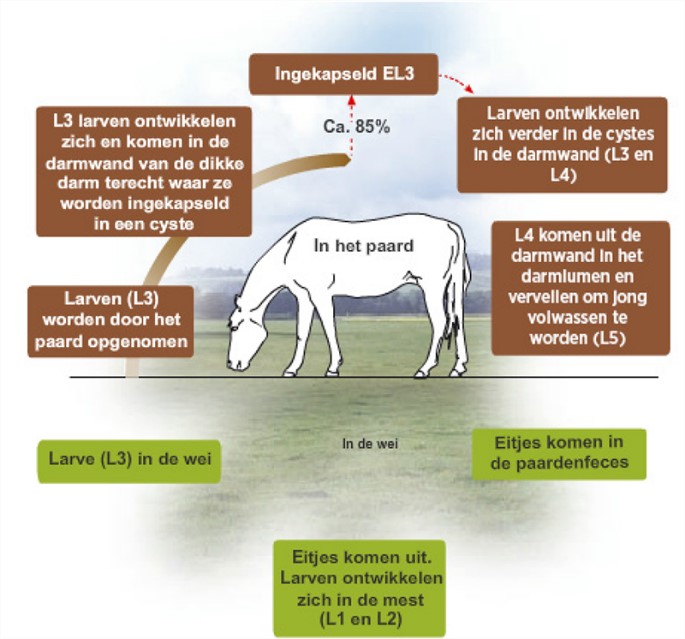
Source: Corning S. Equine cyathostomins: a review of biology, clinical significance and therapy. Parasit Vectors. 2009; 2(Suppl 2): S1
Redworm in horses - symptoms
Redworms in horses can cause various symptoms. In the case of a mild infection, it is possible that a horse shows no symptoms at all. The horse may appear healthy but can still infect other horses. Common symptoms include weight loss, reduced appetite, and a dull coat. Staggering, fever due to a secondary infection, diarrhea, anemia, and colic are also observed. A severe infection can be fatal to the horse or cause permanent damage. Permanent damage can lead to chronic colic, reduced performance, and difficulty keeping the horse at a healthy weight.
Controlling redworm in horses
To investigate whether a horse has redworms, a fecal examination can be performed. This involves looking for worm eggs in the manure. The worm eggs of the large redworm and small redworm cannot be distinguished from one another. Therefore, the result provides the total number of eggs. It is important to note that larvae can be encysted, which means that even with a negative result, there is a possibility that the horse is still infected. When a horse is infected with redworms, a deworming treatment can be administered. Depending on the severity of the infection, the type of veterinary medication to be used may vary. Because resistance to the active ingredients is frequently observed with dewormers, it is advisable to have a fecal examination performed approximately two weeks after administering the treatment.
Preventing redworm in horses
There are various measures you can take to prevent a redworm infection. You can try to keep the contamination of your pasture as low as possible by removing manure (at least twice a week). In addition, you can regularly drag the pasture, clean and disinfect the stable, practice strip grazing, and conduct periodic fecal examinations. This way, an initial infection can be detected in time and further spread can be limited as much as possible.
Recent reading material
5 tips for supporting your horse during autumn

Read more


